


Explore how the claims in Part I: Concerning God depend on one another, with the complete Part I text alongside the map. Select a proposition to move directly to its statement, proof, and notes; select a corollary to jump to that exact paragraph.
An interactive reading companion for Spinoza’s geometric method: definitions and axioms become premises, and propositions become the foundations of later arguments.
- Argument layers arranges statements by their depth in the recorded dependency graph. Follow arrows down from premises to consequences.
- Book order arranges definitions, axioms, propositions, and corollaries in reading order. Use it to relate the map to the progression of the book.
- Local dependencies places a selected statement between its immediate premises and the statements that use it. Use it to understand one argument without the whole graph competing for attention.
Hover over a node to preview its description and highlight its immediate premises and consequences. Keyboard focus provides the same preview. Moving away restores the selected statement’s connections without moving the reader. Click a node or choose a passage from the selector. The reading pane scrolls to the matching passage and highlights it. The map highlights immediate connections, while Uses and Used by provide clickable paths through the argument. Each reading section has a Locate in the map button. Nodes also work with Tab and Enter or Space.
Selections have shareable fragment identifiers, such as #1P14 for Proposition XIV and #1P14C02 for its second corollary. On narrow screens the reader sits below the map. Reduced-motion preferences are respected.
Select a passage and choose Highlight passage. Highlights appear in the reader and as gold outlines in the map. Choose Remove highlight to remove the selected passage’s highlight.
Highlights are saved in this browser’s local storage, separately from the shared text and graph. Storage is specific to the website origin and browser profile: localhost and the live site have separate collections. Clearing site data removes them. If storage is unavailable, the page explains that a download is needed to preserve the collection.
Download highlights exports a versioned JSON file with passage IDs and creation timestamps. Import highlights validates this format and merges it into the current collection, preserving existing highlights. Use export/import to transfer between browsers or keep a backup. No highlights are sent to a server. Highlighting applies to whole passages, rather than selected words.
No build step, package installation, external JavaScript library, or account is required. Serve the repository with a static HTTP server:
python3 -m http.server 8000Open http://localhost:8000. Opening index.html directly as a file will not reliably load the JSON data.
The same files can be served by GitHub Pages or any static host. The original published version is a historical deployment; updating this repository does not automatically update that separate site.
The reader contains all of Part I: its eight definitions, seven axioms, 36 propositions with proofs, notes and corollaries, and the appendix. It uses R. H. M. Elwes’s translation, from Project Gutenberg ebook 3800. This is a public-domain translation, rather than a modern copyrighted edition. Gutenberg identifies its ebook as public domain in the USA; the retained source includes its full distribution notice and licence.
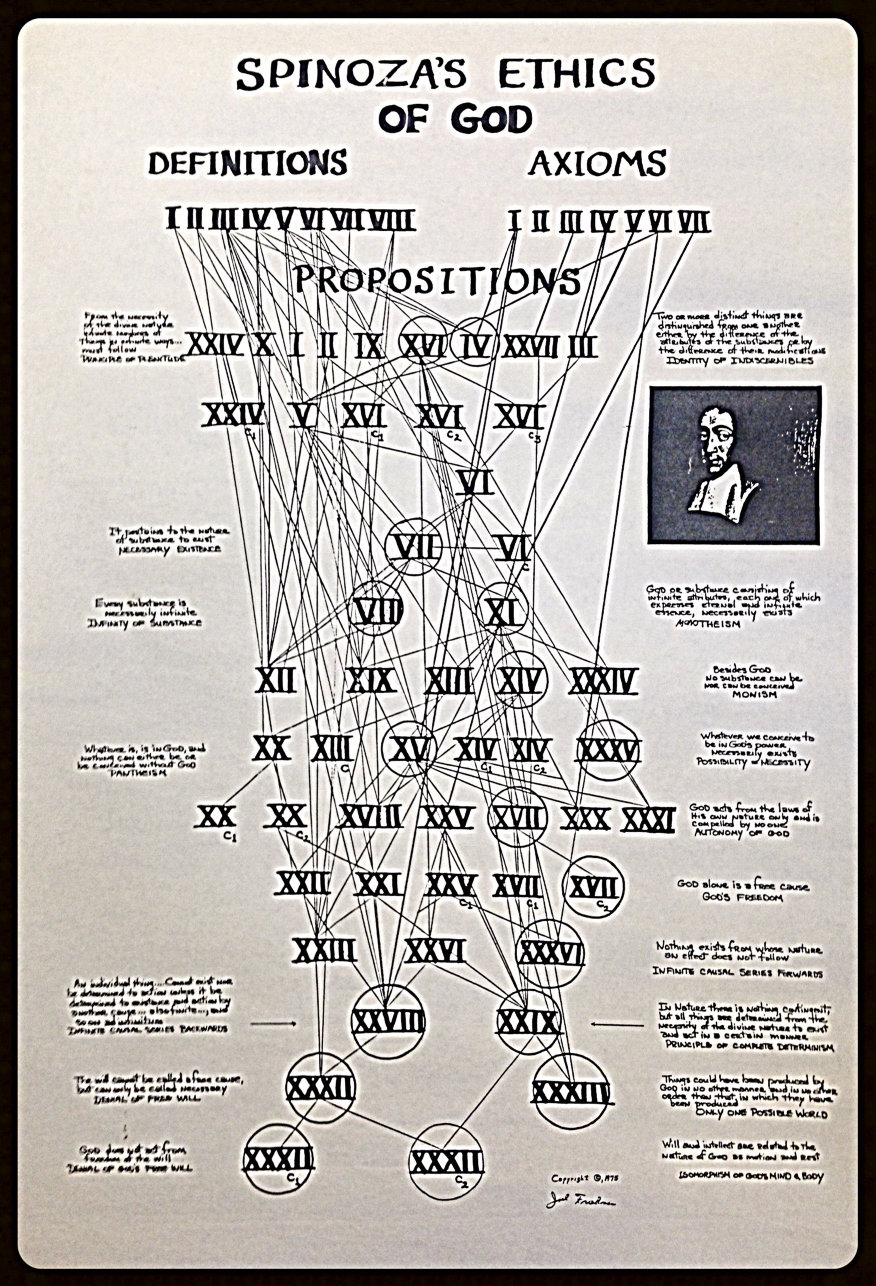
data/elwes-source.txtretains the complete downloaded Gutenberg source, including credits and terms.data/text.jsoncontains the Part I reading sections. Original wording is retained; line wrapping is normalised for display.scripts/build_text.pyregenerates those sections and validates that every graph node has a corresponding text anchor.data/graph.jsonpreserves the 65 nodes and 140 directed links from the original Part I graph, based on data compiled by R. F. Tredwell.
Arrows mean the source is a recorded premise for the target. This is an editorial dependency map, not a formal verification of Spinoza’s proofs. The short node summaries come from the original dataset and may differ from the Elwes wording; the reader provides the source text. Parts II–V are not currently mapped or displayed.
The original visualisation followed Friedman’s poster. The legacy scripts and images remain in the repository as historical reference; the new page uses app.js and styles.css.
Corrections to dependency links and short summaries are welcome. Please cite the relevant part, proposition, proof, or corollary, and explain whether the change corrects a transcription error or proposes a different interpretation. For text corrections, update the retained source deliberately and regenerate:
python3 scripts/build_text.py
node --check app.js
Before submitting interface changes, check all three views, proposition and corollary navigation, keyboard selection, fragment links, and the stacked layout on a narrow screen.
The application retains the repository’s GNU GPL version 2 licence. The underlying historical translation is public domain; the retained Project Gutenberg source carries its own distribution notice. Dependency-data attribution to R. F. Tredwell is preserved.
Choose Line of argument in the view selector to read the selected statement’s complete chain of recorded premises as numbered text steps. Dependencies appear before the statements that use them; shared premises appear once. Each step includes its source statement and immediate premise references. Click a step to select it and read its full proof in the reading pane. This view expands the editorial dependency dataset; it does not claim to reconstruct a unique or formally verified proof.