




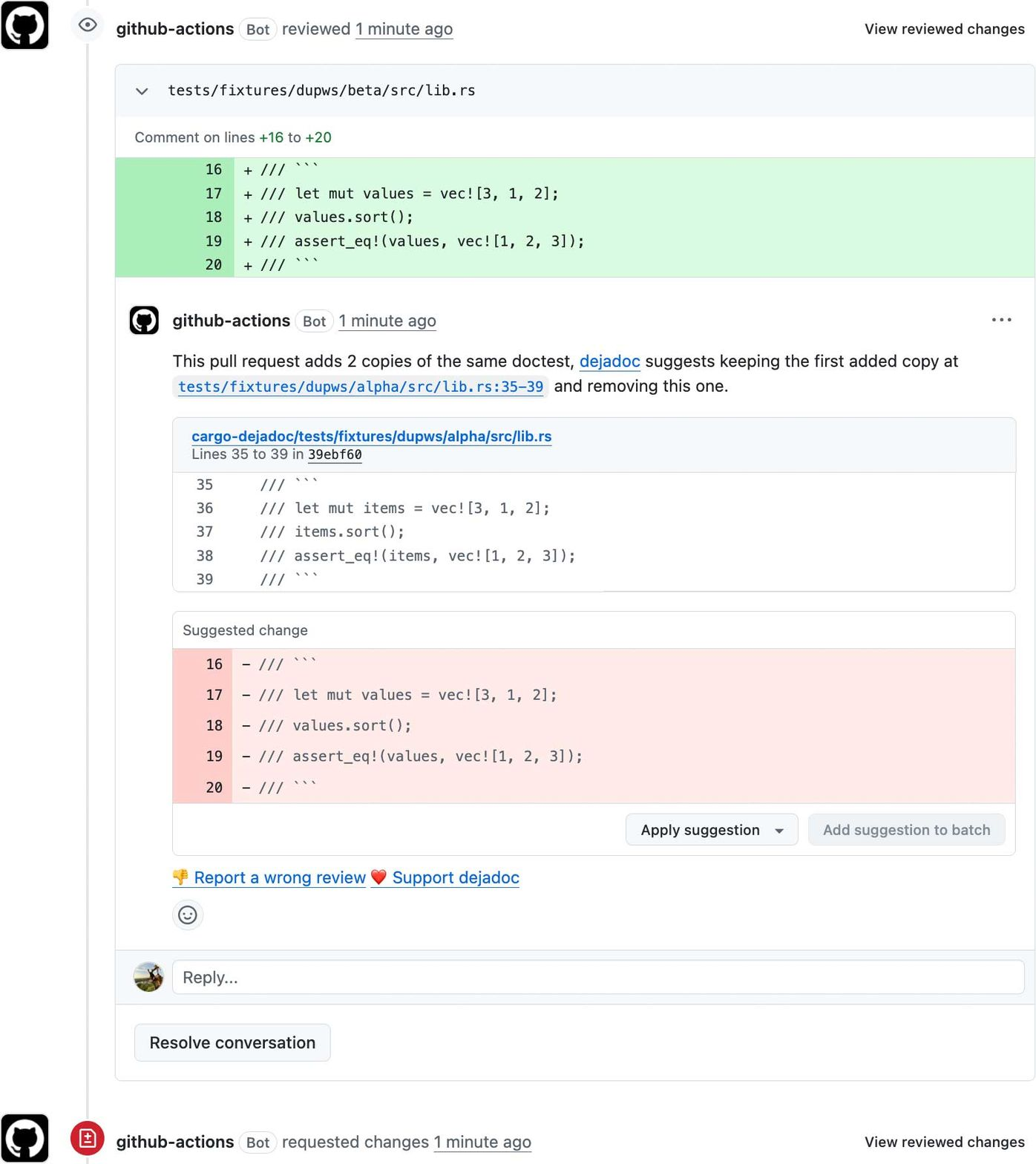
Whoa, deja vu. A doctest went past us, and then another that looked just like it.
cargo dejadoc finds duplicated Rust doctests and optionally checks functions and lexical contexts across a workspace.
| Check | Enable | Default minimum size | Set the size |
|---|---|---|---|
| Doctests | On by default | 0 tokens |
--min-tokens |
| Functions | --functions |
30 weighted body tokens |
--fn-min-tokens |
| Contexts | --context-blocks |
30 canonical weighted tokens |
--context-min-tokens |
Groups need at least 2 sites by default, configurable with --threshold. Size floors are inclusive and independent. For functions and contexts, a path, lifetime or multi-character operator counts as one token, while commas and grouping delimiters count as zero.
Defaults come from .dejadoc.toml at the workspace root, with command-line options taking precedence. Set functions = true or context-blocks = true to enable the optional checks, and context-min-tokens = 30 to set the context floor. See cargo dejadoc --help for package selection, additional targets and JSON output.
Generated files are skipped when their first five lines contain @generated or a // Code generated … DO NOT EDIT. marker. Configure generated-markers for other generators or scan-generated = true to include their output.
Doctest and function groups identify a copy to keep, preferring one that references its own item, then file and line order. Use rust,dejadoc on a doctest fence or // dejadoc: allow above a function to keep an intentional copy.
Functions compare within their module across targets and cfg variants, keeping test markers, should_panic and ignore distinct. Only eligible free functions and inherent methods receive deletion suggestions. Library public API, exported symbols and differing cfg or self types require refactoring.
Whole function bodies, explicit blocks, complete match arms and closures are normalized independently using syn-canon. Arm patterns and guards and closure inputs contribute to the canonical size.
These are approximate matches with unverified enclosing semantics. context_groups carries original half-open ranges with one-based byte columns, including BOM and shebang files. Context matches have no keeper or deletion advice and never feed Action reviews.
A smaller group is hidden only when one larger matching group contains every site.
cargo dejadoc --context-blocks --context-min-tokens 30The action installs the crate and reports findings in a pull request review, job summary and annotations.
on: pull_request
jobs:
  dejadoc:
    runs-on: ubuntu-latest
    permissions:
      contents: read
      pull-requests: write
    steps:
      - uses: actions/checkout@v4
      - uses: dtolnay/rust-toolchain@stable
      - uses: LucaCappelletti94/cargo-dejadoc@v1
        with:
          # Review the pull request instead of failing the job. Drop it to gate a push.
          pr-number: ${{ github.event.pull_request.number }}
          # Report duplicates that predate the pull request too, default `false`.
          only-new: false
          # Report a group from this many copies, default `2`.
          threshold: 2
          # Ignore doctests below this token count, default `0`.
          min-tokens: 0
          # Check for duplicated functions too, default `false`.
          functions: true
          # Ignore functions whose body counts fewer tokens than this, default `30`.
          fn-min-tokens: 30
          # Scan bin and example doctests as well as lib ones, default `false`.
          all-targets: true
          # Restrict to one workspace member, and scan from a subdirectory.
          package: mycrate
          cwd: .
          # Annotate each copy to remove, default `true`.
          annotations: true
          # Render the review in the job summary instead of posting it.
          dry-run: false
          # Use the `cargo dejadoc` already on the path instead of installing one, default `true`.
          install: true
Review mode reports newly introduced duplicates by default. Removal suggestions appear on eligible copies, with links to the kept copy. Omit pr-number to fail the job on duplicates, or set only-new: false to include pre-existing copies.
Fork pull requests receive summaries and annotations because their token is read-only. For review comments on forks, use mode: prepare and mode: post in separate workflows following the workflow_run security pattern. The privileged posting job must never check out or execute pull-request code.
Two workflows, so forks keep the removal suggestion
# .github/workflows/dejadoc.yml
name: dejadoc
on: pull_request
permissions:
  contents: read
jobs:
  dejadoc:
    runs-on: ubuntu-latest
    steps:
      - uses: actions/checkout@v4
      - uses: dtolnay/rust-toolchain@stable
      - uses: LucaCappelletti94/cargo-dejadoc@v1
        with:
          pr-number: ${{ github.event.pull_request.number }}
          mode: prepare
          payload: dejadoc-payload
      - uses: actions/upload-artifact@v4
        with:
          name: dejadoc-payload
          path: dejadoc-payload
# .github/workflows/dejadoc-post.yml
on:
workflow_run:
workflows: [dejadoc]
types: [completed]
jobs:
post:
runs-on: ubuntu-latest
permissions:
actions: read
pull-requests: write
steps:
- uses: actions/download-artifact@v4
with:
name: dejadoc-payload
path: dejadoc-payload
run-id: ${{ github.event.workflow_run.id }}
github-token: ${{ github.token }}
- uses: LucaCappelletti94/cargo-dejadoc@v1
with:
mode: post
payload: dejadoc-payloadThe payload carries the pull request number, head commit and rendered comments. The posting job consumes only that data and needs no checkout, toolchain or scanner installation.
See action.yml for all inputs.
Use dejadoc = { version = "0.5", default-features = false, features = ["std"] } for in-memory reports without the CLI. Scanning compiles no code and includes all cfg variants in one run.
let report = dejadoc::Dejadoc::default()
    .functions()
    .context_blocks()
    .run(".")
    .unwrap();
println!("{}", dejadoc::human(&report, false));
Coding agents get the same guidance from the dejadoc skill, installed with the skills CLI.
npx skills add LucaCappelletti94/cargo-dejadoc